DecisionProPublic Program Decision Intelligence

Multi-state public program decision intelligence · Medicaid first

Public evidence for public decisions.

DecisionPro joins federal and state public data into one sourced record for state legislators, legislative fiscal and oversight staff, and Medicaid program leaders. Every figure names its source and publish date. Every reading is a question for review.

  • Public data only
  • Aggregate, no person-level data
  • Sources named and dated
  • No figure for fewer than 11

A product of XenoDroid Inc.

Sourced

Every figure, traced.

Each figure carries its publisher, dataset and publish date, and links back to the source of record. The publisher stays the authority.

Aggregate

No person-level data.

Public, aggregate data only. No protected health information, no member records, and no figure for any group of fewer than 11.

For review

Questions, not findings.

Readings are framed as questions for a reviewer. DecisionPro shows what deserves a closer look; people decide what it means.

The standard of evidence

Every figure has a source. Every reading is a question.

Oversight work is only as strong as the record behind it. DecisionPro keeps observed facts, analytical transformations, modeled estimates and human decisions distinct, so a committee, an auditor or a program office can see exactly what a number is and where it came from.

  1. Public sources, named and dated

    Federal and state publishers remain the source of record. Each figure names its publisher, dataset and publish date, with a link to the original.

  2. Aggregate only

    No protected health information and no person-level Medicaid records. Analysis runs on published aggregates and organization-level public filings.

  3. Small cells withheld

    No figure is shown for any group of fewer than 11. The row says so, rather than disappearing.

  4. Observed, inferred or gap

    Each reading is labelled by kind. When a source is not yet loaded, the gap is shown with what would close it, instead of being filled in.

  5. Questions for review, not findings

    Screens surface candidates for a reviewer. No reading is a determination about a program, plan or organization.

  6. Modeled is not realized

    Modeled benefit and realized value are tracked separately. Export restrictions set by a publisher are respected.

Sources include

  • CMS
  • HHS T-MSIS provider spending
  • CMS monthly enrollment
  • NPPES
  • USAspending
  • SAM.gov
  • IRS Form 990
  • CMS HCRIS cost reports
  • CMS ownership data
  • CMS §1115 demonstrations
  • Grants.gov
  • Kentucky DMS
  • Florida AHCA

Operational Intelligence

A public fact, and the question it raises.

Above each state’s operational goals sits the operational briefing: a ranked set of headlines that join facts no single publisher shows together. Each one states the joined public fact and the open question. None states a verdict.
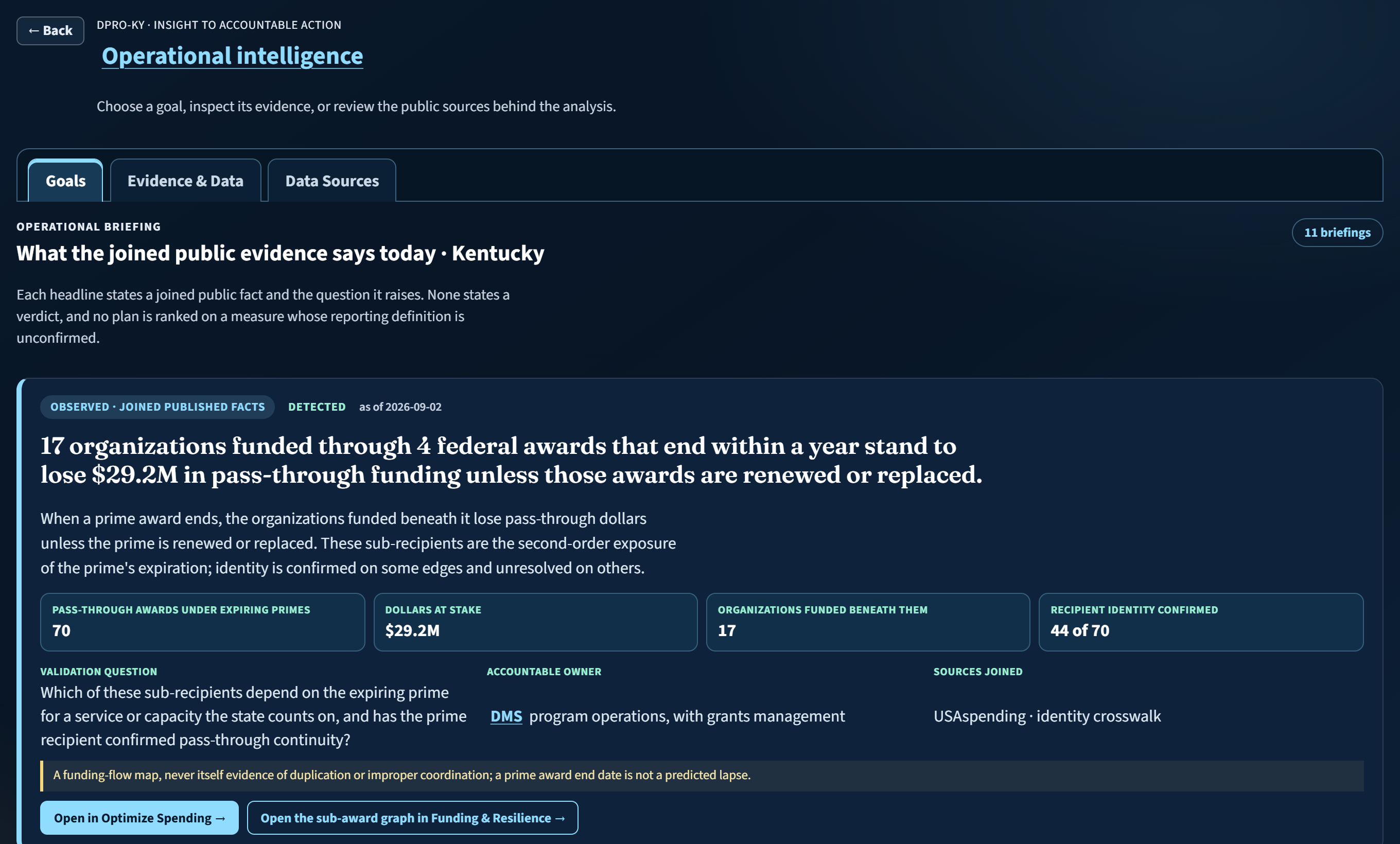
DecisionPro Kentucky · Operational intelligence Briefing
DecisionPro Kentucky Operational Intelligence page with the operational briefing: an observed headline, its figures, the validation question, the accountable owner and the sources joined
The briefing, in the product. Each headline carries its figures, a validation question, an accountable owner and the sources it joins.

How a headline earns its place

  • Fact and question Written in the language of programs, dollars, facilities and people, never data-model terms.
  • Ranked by decision value Goals touched first, observed before inferred, nearest deadline next. Never novelty.
  • Verdict language barred Terms that pass judgment are kept out of headlines and checked by automated test.
  • Gaps stay visible When a source is not loaded, the headline says so and names what would close the gap.
Observed

Every figure is a published fact joined on an exact key.

Inferred

A declared threshold or rule selects the rows.

Gap

The join cannot run yet; the card names what unblocks it.

Kentucky Observed

Kentucky’s 6 MCO contract plans report appeal rates that differ 121.3×; the spread reflects counting rules, not performance, until each plan’s definition is confirmed.

Spreads that wide reflect how each plan counts, so a plan ranking on these measures would misstate performance.

Florida Observed

11 Florida organizations draw $2.2B under more than one federal program; whether that funds two services or one service twice is unverified.

Receiving funds under two programs is not itself duplication. The list is where a scope reconciliation starts.

Kentucky Inferred

10 Kentucky health-center awards expire within a year; 5 federal successor opportunities are open for the same program, and renewal is unconfirmed for 10 of the 10.

Federal successor funding is already posted for the listing these awards sit under. Whether each recipient applied is the open question.

Headlines quoted from the product’s briefing. Figures change as sources refresh.

Funding & Resilience Evidence Room

Medicaid care is delivered by organizations. Their funding is on the public record.

Nursing-facility chains, nonprofit health centers, hospitals and grantees carry Medicaid capacity. The Funding & Resilience Evidence Room joins nine federal sources into one governed picture of those organizations: who funds them, who owns them, and where a funding cliff or a thin balance sheet deserves a closer look before it becomes an access problem.

Questions it answers in plain terms

  1. Which organizations deliver Medicaid-related capacity, and who funds them?
  2. Which federal awards expire within a year, and who loses pass-through funding if they are not renewed?
  3. Which nonprofits hold less than three months of reserves, two filings running?
  4. Which facilities lose money on a high-Medicaid payer mix, and which counties depend on them?
  5. Which chains run how many facilities, and what changed recently?
  6. Where does money flow from prime awards down to sub-recipients?
9 federal lineage sources
10 signal types in each state’s room
2,863 organization signals · 1,530 Kentucky / 1,333 Florida

Every signal is a review candidate, not a finding.

  • Federal award expirationAwards approaching their end dateUSAspending
  • Single-stream dependencyOrganizations relying on one award streamUSAspending
  • Identity crosswalk, exactSame organization confirmed across sourcesSAM.gov
  • Identity crosswalk, inferredA probable match, always labelled a review candidateSAM.gov
  • Nonprofit resilienceMonths of reserves on handIRS Form 990
  • Facility financial signalCost-report operating marginsCMS HCRIS
  • Common-ownership chainFacilities under shared ownershipCMS ownership data
  • Sub-award funding edgePrime to sub-recipient flowUSAspending
  • Waiver horizonDemonstration key datesCMS §1115
  • Open grant opportunitySuccessor funding postedGrants.gov

Governed to be trusted

  • Review candidate, not a finding. No funding amount, ratio, ownership link or network position is presented as a conclusion.
  • Exact and inferred never mix. Confirmed identity links and probable matches are kept apart and labelled.
  • Gaps, not blanks. A blocked source becomes a labelled gap with a path to unblock it, never a stand-in figure.
  • Organizations only. No person-level records. Owner names that are not organizations are withheld.

Potential Fraud Detection

A national screen of Medicaid spending. Candidates for review, not findings.

The Potential Fraud Detection module sets what each state pays for each Medicaid service against that state’s share of national enrollment, across every state. A service and year that sits above the line becomes a candidate for a reviewer, with the public evidence behind it and the checks still to run.

Every candidate is a question for a reviewer, not a finding. The module makes no determination about any state, service or biller, and shows no figure for a group of fewer than 11 billers.

  1. I

    National screen

    State-and-service spending against enrollment for every state, with filters by year, tier and pattern, and an adjustable scoring rule.

  2. II

    Case files

    For one candidate: the checks that fired, the checks that cleared, the checks waiting on data, and a reviewer’s disposition.

  3. III

    Early warning

    When a rise could first have been seen in monthly payments, set beside the annual screen and the first restriction on file.

  4. IV

    Follow the billers

    Where a group of billers turns after a service changes. Counts and dollars only; no biller is listed.

  5. V

    Explanation ledger

    Before a rise is called unexplained, the dated law, policy and reporting changes on file that could explain it.

  6. VI

    State oversight brief

    For one state, the latest year’s services above its enrollment share, with three questions a legislator can ask.

Built on

  • HHS T-MSIS provider spending
  • CMS monthly enrollment
  • NPPES, counts only
  • Dated law and policy events on file
  • Backtests against known cases

Legislative modeling and district views

Built for the hearing room and the home district.

Legislators, budget analysts and program staff each open on the evidence they use: district impacts, constituent access, and options to examine before a hearing or floor debate.
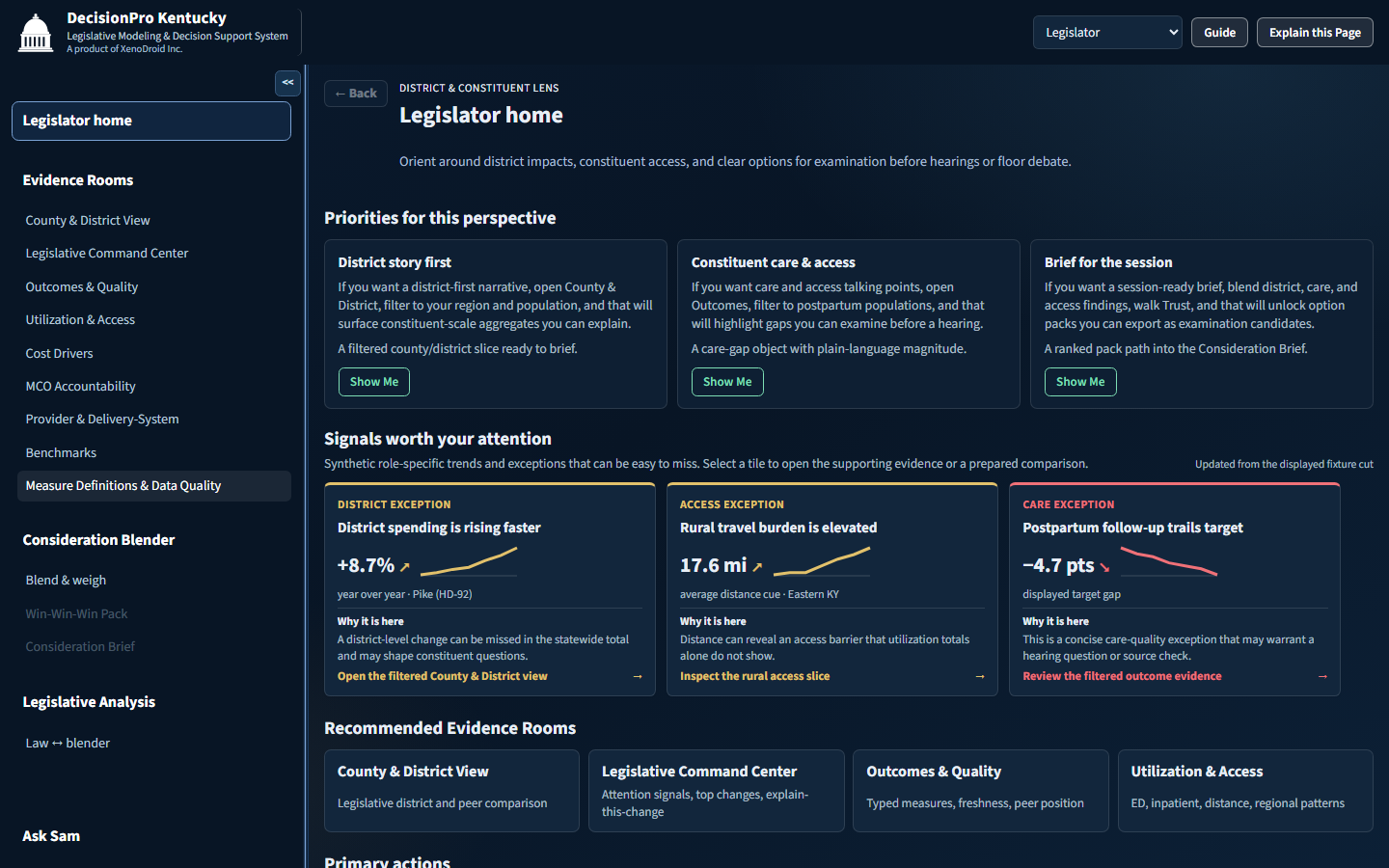
DecisionPro Kentucky · Legislator home Role view
DecisionPro Kentucky legislator home with priorities for the perspective, signals worth attention and recommended Evidence Rooms
Legislator home. District story, constituent care and access, and a brief for the session.
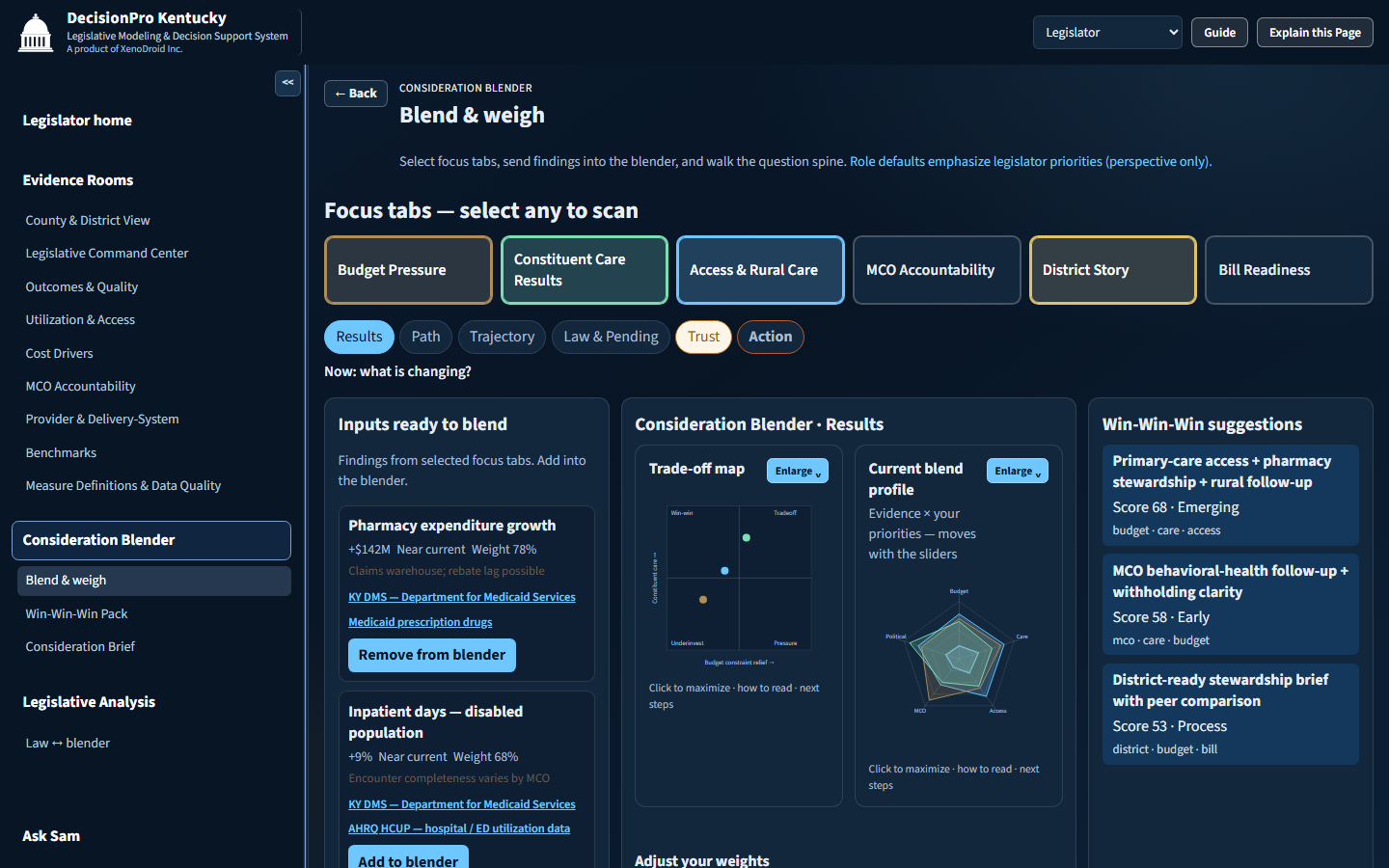
DecisionPro Kentucky · Consideration Blender Weigh
DecisionPro Kentucky Consideration Blender with focus tabs, inputs ready to blend with their sources, a trade-off map and a blend profile
Consideration Blender. Evidence weighed against declared priorities, each input with its source attached.
  • County & District View

    County and legislative district aggregates set beside the state, filtered by population, region and period.

  • Legislative Command Center

    Attention signals, top changes and data freshness across the state’s Medicaid aggregates.

  • Consideration Blender

    Blend budget, care, access and plan accountability evidence into options, then into a consideration brief.

  • Legislative analysis

    Link enacted and pending law to the evidence it touches, with the options framed for examination.

State products

Each state keeps its own sources, definitions and law.

DecisionPro is one platform with explicit state products. Each keeps its agencies, reporting periods and publishers; the path from evidence to decision stays the same.

DecisionPro Kentucky

Legislative Modeling & Decision Support System

Role-based Kentucky Medicaid intelligence spanning enrollment, spending, access, quality, contracts, providers, districts, operational recommendations and recovery review.

  • 10 Kentucky Evidence Rooms
  • 6 quantified operational goal portfolios
  • Recovery reconciliation workpaper
  • Consideration Blender and legislative analysis
Open DecisionPro Kentucky

DecisionPro Florida

Public dashboard evidence, put to work

Connects Florida AHCA’s public dashboard suite and federal managed-care evidence to analysis, opportunities, workpapers, decision reports, owners and benefit measurement.
  • 9 Florida Evidence Rooms
  • 11 AHCA dashboard domains connected
  • Source-native and normalized analysis
  • Action and realized-value tracker
Open DecisionPro Florida
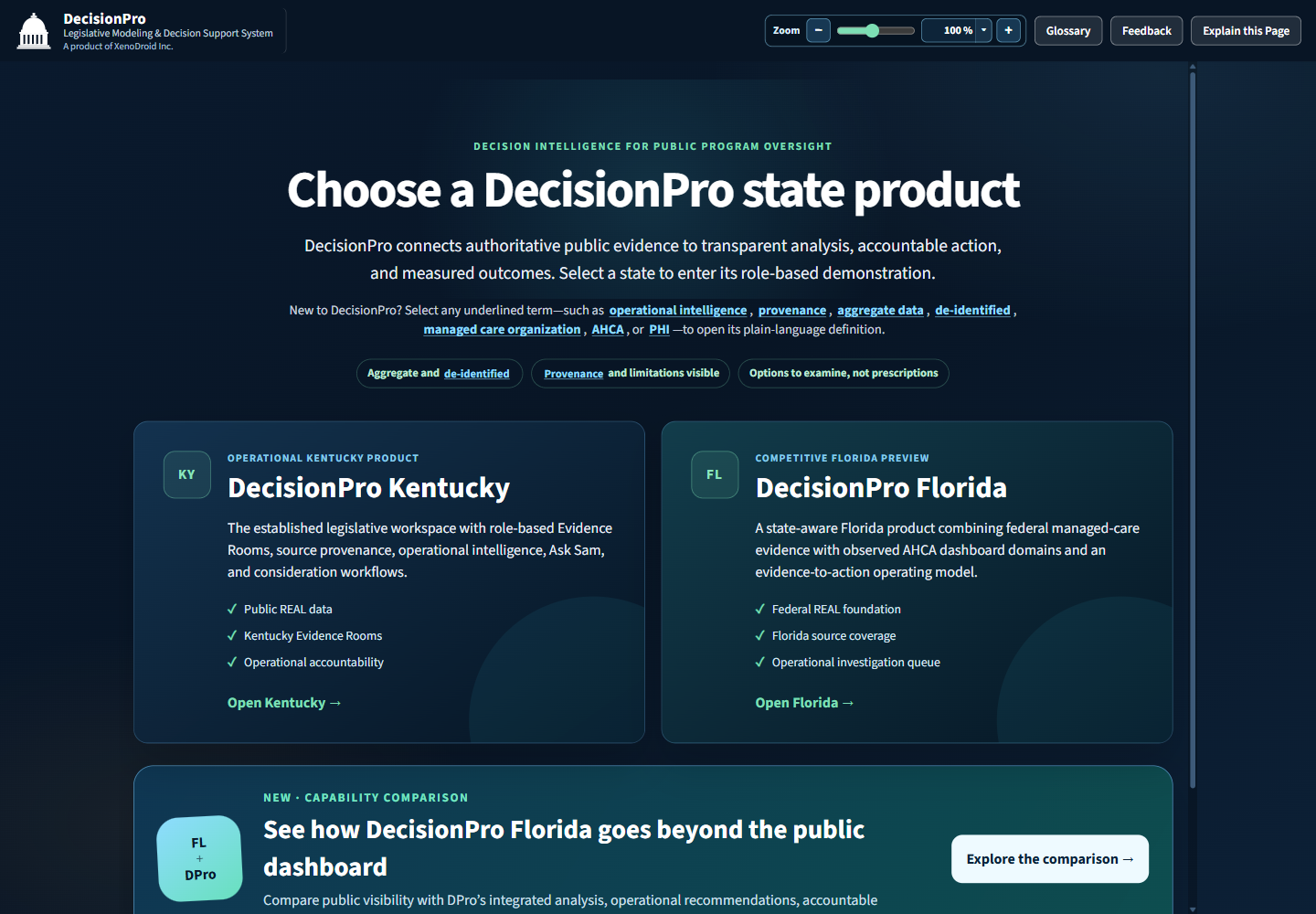
DecisionPro · State products Select
DecisionPro state-neutral landing page with Kentucky, Florida and public-dashboard comparison choices
Choose the state, keep the method. State identity stays explicit in the address, sources and rooms.
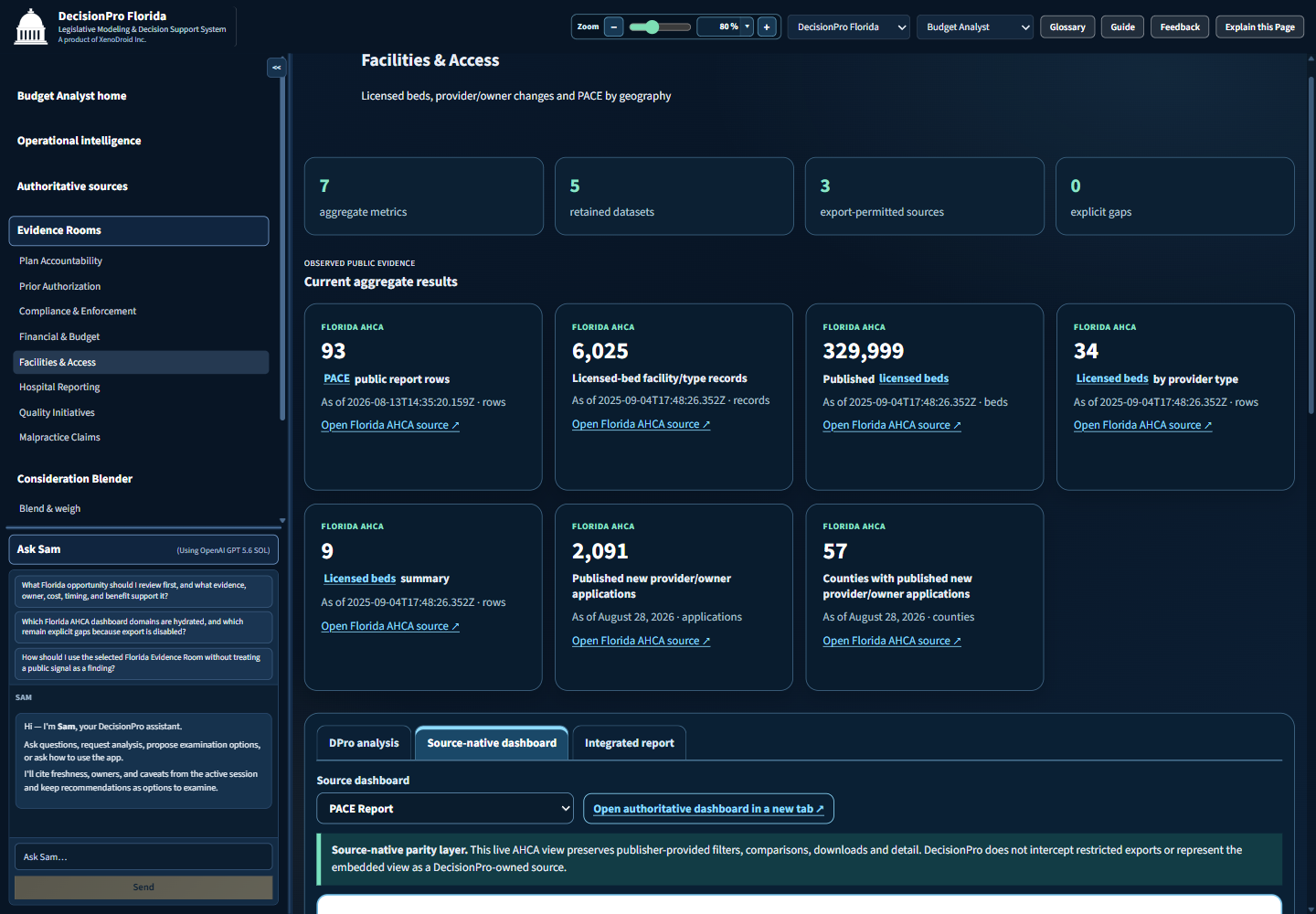
DecisionPro Florida · Facilities & Access Evidence Room
DecisionPro Florida Facilities and Access Evidence Room with aggregate results, each linked to its Florida AHCA source with an as-of date
Every aggregate dated and linked. Each result opens its Florida AHCA source; the source-native dashboard stays one tab away.

The questions align. The evidence stays state-specific.

DecisionPro offers a comparable lens without treating different agencies, reporting periods, measures or laws as the same thing.

Decision lens Kentucky Florida Shared DecisionPro layer
Primary context Legislative oversight, Medicaid operations, districts, budgets, contracts and policy options AHCA public dashboard domains, managed care, facilities, quality, utilization and access Role-aware navigation with explicit state, source, definition and period context
Opportunity framing Quantified operational goals and recovery-review candidates Weighted opportunities derived from permitted public evidence and declared gaps Inputs, transformations and accountable actions, with confidence and guardrails
Decision output Legislative analysis, consideration blending, workpapers and oversight briefs Integrated reports, source-native views, action tracking and decision packages Owners, priorities, due dates, modeled benefit, realized value and an audit trail
Comparison rule Kentucky measures keep Kentucky definitions and reporting windows Florida measures keep AHCA and owning-publisher definitions and restrictions Normalize only when definitions and grain align; otherwise explain the difference

Everything public stays reachable. DecisionPro adds the decision layer.

DecisionPro complements authoritative state publishers. It does not claim ownership of their dashboards or work around their restrictions.

Capability Public dashboard experience DecisionPro
Discovery Publisher- and program-specific destinations Unified state catalogue and Evidence Rooms with source-native links
Analysis Native filters, charts, comparisons and downloads Keeps native interaction and adds normalized cross-source comparisons
Governance Definitions and context remain with each publisher Provenance, freshness, content hashes, limitations, gaps and reconciliation status
Action Supports monitoring and investigation Quantified opportunities, owners, due dates, status and workpapers
Reporting Dashboard- and export-specific outputs Integrated reports, executive briefs, option packs and legislative framing
Benefit No cross-dashboard realization workflow is assumed Modeled benefit and realized value tracked separately

For legislators, fiscal and oversight staff, and Medicaid program leaders

Bring your question. See the public evidence behind it.

The demo runs on the public sources named here, with the Kentucky and Florida products and the Potential Fraud Detection module.